When Pain and Joy Coexist: Lessons From My Dad's 80th Birthday
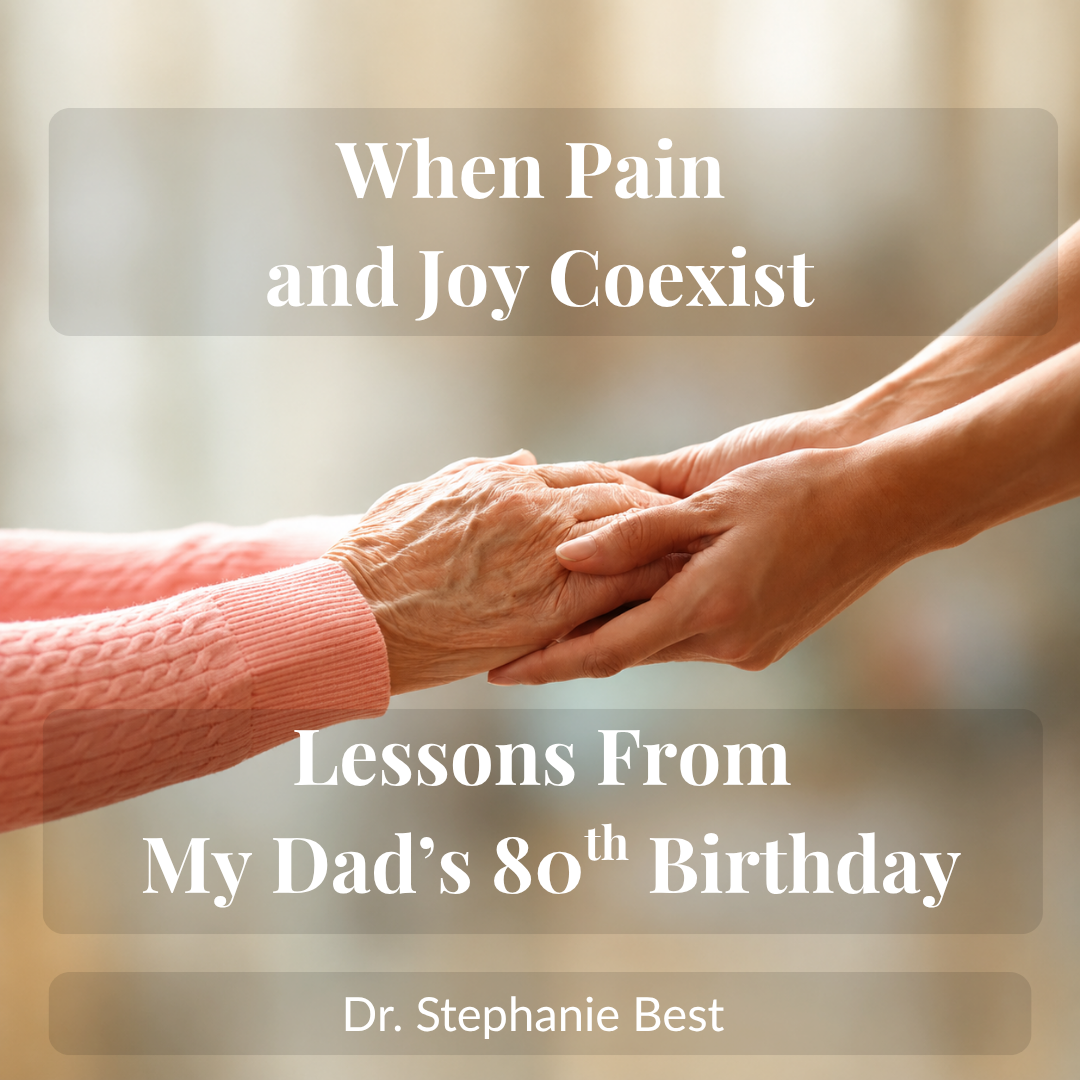
We've been glued to World Cup soccer in our house lately — the thrill of victory, the agony of defeat. No way to have one without the other. Then last week I drove to Virginia and lived out that exact same equation, off the screen and in real life. Within a 24-hour span, I was squeezing the hand of someone I love while she cried through nausea, pain, frustration, and fear. Hours later, I was crying tears of joy, toasting my Dad turning 80, surrounded by people I cherish. Both were real; both were true. At the same time.
If you've ever felt like your emotions don't make sense together — like grief and gratitude, love and loss, celebration and heartbreak sharing the same day — this post is for you. Coping with emotions that seem to contradict each other is normal. It's often the clearest sign of what matters most to you. 🧭
Prefer to watch? Here's the full video:
Why Pain and Joy Show Up Together — A Lesson From My Dad's 80th Birthday | Dr. Stephanie Best
Why Pain Isn't a Malfunction
Dr. Steven Hayes, one of the founders of Acceptance and Commitment Therapy (or ACT), puts it simply: "We hurt where we care, and we care where we hurt." Pain and love are two sides of the same coin.
Once you start looking for it, that idea shows up everywhere. You don't get the depth of love without the risk of loss. You don't get the elation of joy without the ache of sadness sitting somewhere nearby. That's the system — the rules of Club Human, if you will.
The reason it hurt to watch someone I love suffer wasn't a malfunction. It was proof of how much she matters to me, how much our relationship has shaped my life. And the reason my Dad's 80th birthday brought me to tears was the same thing: that same love, showing up as joy instead of grief. One doesn't cancel the other out. One dignifies the other. 💞
Coping with Emotions You'd Rather Not Feel
Most of us are taught, directly or indirectly, to push away the feelings that hurt. Grief, fear, disappointment, envy. . . we treat them like malfunctions to fix instead of information to notice.
But avoiding a hard feeling doesn't make it smaller. Usually it makes it louder. If you've ever attempted to white-knuckle your way through a difficult emotion, you already know how exhausting that fight is! (P.S. Instead of white-knuckling, try the 3-step ‘Dropping Anchor’ technique to help ground yourself the next time an emotional storm is brewing. ⚓)
Coping with emotions skillfully means learning how to be with them — not attempting to fix, eliminate, or rush past them. That's different from wallowing, and it's different from toxic positivity too. It's closer to willingness: letting a hard feeling exist alongside other aspects of your experience, instead of needing it to leave before you're allowed to feel okay again.
A Simple Way to Make Room for the Hard Stuff
If you're wondering how to actually practice willingness, not just read about it, try this little 1-minute exercise:
Pick an inner experience (a tough emotion, an uncomfortable thought, or a painful sensation) you've been resisting lately. Start small. Set a 1-minute timer on your phone or watch, then visualize one of the following:
Embrace the feeling or experience the way you'd embrace a crying child.
Imagine holding it in the palm of your hand, like a baby bird with a broken wing.
Abandon the fight with your experience, the way a soldier might lay down his or her weapons at the end of a war, to walk home.
Your mind might protest, "I don't know how to do this!" That’s a completely normal thought to have. Notice it, thank your mind for that thought, and keep trying anyway. This exercise isn't about getting it right or wrapping your mind around it. It’s about practicing turning toward your experience, instead of away from it. You don’t have to like it. You don’t have to want it. You’re simply making room for it, just for a minute. 🌱
The Takeaway
Being human is an all-of-the-above kind of equation. If you're carrying something hard right now alongside something joyful, that's evidence of a full life, not a contradiction. Pain, loss, and grief are the admission price of love, and most days, that price is worth paying a hundred times over.
If you have a friend or family member who’s going through something hard right now, send this to them. It might help them make room for the ache and stay connected to the caring inside of it. 💝
Ready to take the next step?
If something here resonated with you, I'd love to stay connected. Here are 3 ways to go deeper:
🌿 Download my FREE guided meditation — a practical first tool for the moments when anxiety gets loud.
💌 Join the Courageous Living newsletter — honest insights, tools you can actually use, and the occasional irreverent truth delivered to your inbox. No spam, no hustle culture.
▶️ Subscribe on YouTube — new videos every few weeks. Radically genuine real-talk psychology that's values-driven and always unscripted.
And if you're in a place where 1-on-1 support feels like the right next step, I'd love to connect. I'm a therapist in Charleston, SC who works with clients across the U.S. via PSYPACT — you can reach out here.
We've been glued to World Cup soccer in this house. The thrill of victory, the agony of defeat. No way to have one without the other.
Then last week, I drove to Virginia to experience pure joy celebrating my dad's 80th birthday. And grief watching another beloved family member navigate a serious health scare. Different context, same equation.
Hi, I'm Dr. Stephanie Best. I'm a licensed clinical psychologist and I inspire humans with anxiety to live courageously by teaching them how to build lives they love through mind-body wellness.
So I drive up to Virginia, and literally within the same 24-hour span I'm squeezing the hand of someone I love dearly while she cries and suffers with nausea, pain, frustration, fear. Then I'm crying tears of joy hours later, toasting my dad turning 80, surrounded by people I cherish and so keenly aware of how special this event is. Both real, both true, at the same time.
So Dr. Steven Hayes, one of the greatest psychologists in the world and the primary founder of Acceptance and Commitment Therapy, or ACT — the type of therapy that I practice — likes to say that we hurt where we care, and we care where we hurt. They're sort of flip sides of the same coin. Pain isn't a malfunction. It's proof of what matters to you.
You don't get the depth of love without the risk of loss. You don't get the elation of joy without the pain and the soreness of sadness, right? That's not a flaw in the system. That's the system. It's the rules of Club Human, if you will, you know?
So what do you do with that? How do you cope with that bit of reality that is so very hard for all of us to accept?
Pick one feeling or one experience, an inner experience that you've been resisting lately. Maybe pick something small to start. And then for about a minute — maybe set a little 60-second timer — try visualizing one of these images.
Embrace it the way you'd embrace a crying child. Or imagine holding it in the palm of your hand like a baby bird with a broken wing. Or abandon the fight with your experience the way a soldier might lay down his or her weapons at the end of a war to walk home.
Your mind might protest some of these images: "I don't know how to do that." That's fine. Thank your mind for that thought, and then keep trying. The point isn't to get it right. It's not to understand the exercise. It's a little something to unhook you from your thoughts, from the story your mind is telling you, and help you practice turning toward your inner experience instead of away from it.
Being human is an all-of-the-above kind of equation, right? The reason that it hurts for me to watch my loved one suffering is because I care about her. Is because I am close to her. It's because she has brought so much to my life. Because this relationship has been part of what's made my life worth living.
You know, pain, loss, grief — they're the admission price of love. And frankly, I would pay that price 100 times out of 100, because it's the same love that's linked to the pain, to the fear of loss. It's that same love that led me to cry tears of joy at my dad's 80th, seeing his big smile with his family members around him. All he wants in this world is just to have his family members together in his presence, just enjoying funny stories, laughing about old memories, eating delicious food, hugging, cherishing time together.
You don't get to have the sweetness of that without also having the sourness of pain and loss. But one can dignify the other. Okay?
So if you have a friend or a family member who's going through something hard right now, send this to them. It might help them make room for the pain and even connect with the caring inside.
Thanks for listening. I'll see you next time.