Real Wellness Isn't Perfect: On Anxiety, Perfectionism, and Showing Up Anyway
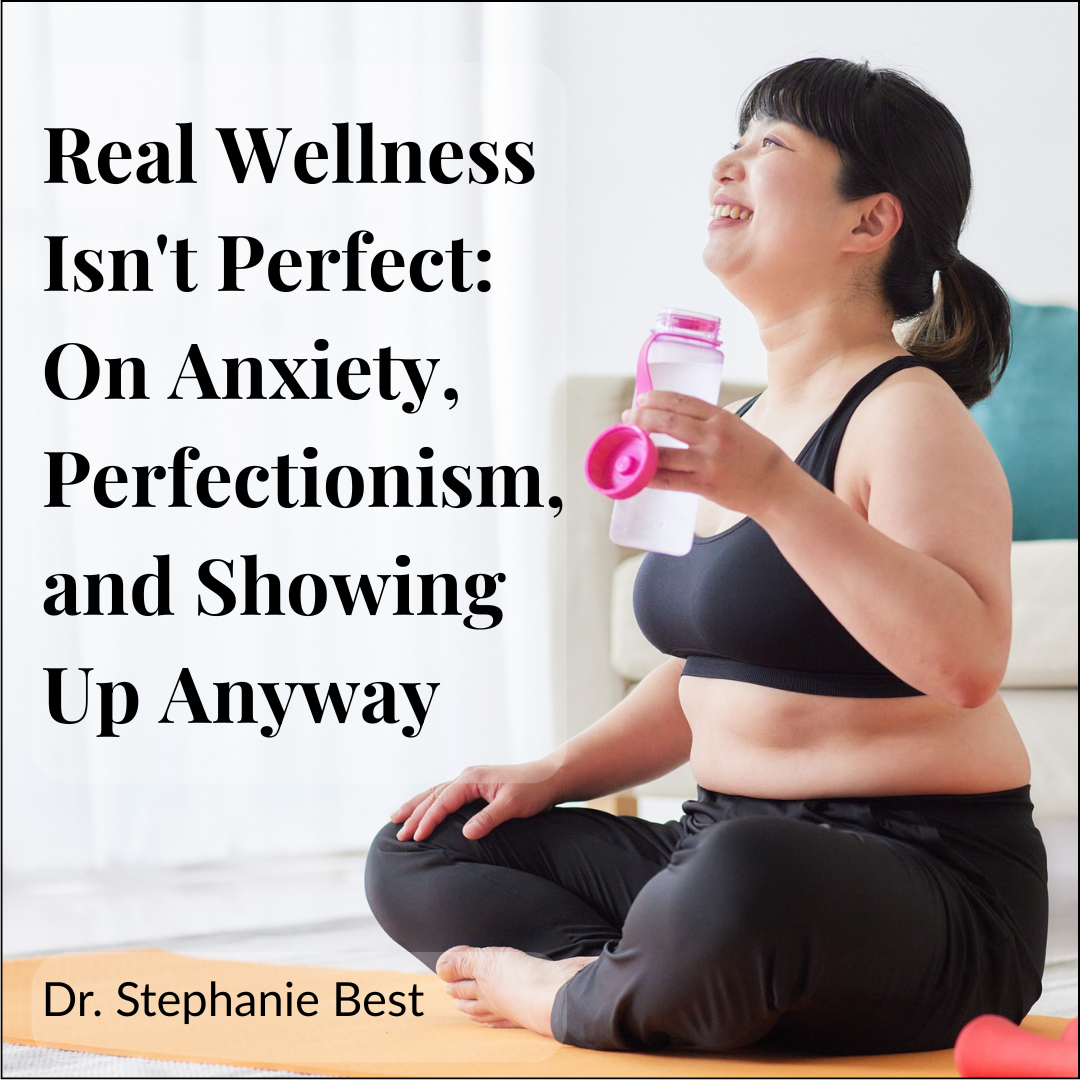
I recorded the most recent video for my YouTube channel with zits on my face, flyaways in my hair, and yoga clothes I'd already worked out in.
Not because I didn't notice. I noticed. My mind had a whole lot to say about it, actually — the usual perfectionist highlight reel: “I can't believe I have zits. I'm recording today. Great.” My first instinct was to postpone or hide my perceived flaws. 🫣 But then I heard another inner voice, the wiser one I've spent 20 years carefully cultivating: “No. We're going to do exactly the opposite. We're going to show up as-is.” 💪🏼
So I did. And I want to tell you why — because it has everything to do with anxiety and perfectionism, and the sneaky way they work together to keep us on the sidelines of our own lives.
Prefer to watch? Here's the full video:
I Recorded This With Zits and Fly-Aways — Because Wellness Isn't Perfect | Dr. Stephanie Best
The Four Cornerstones of Whole-Person Wellness
We've talked a lot in this “Courageous Living” community about psychological flexibility — your ability to make space for uncomfortable thoughts and feelings, stay grounded in the present, and show up in the ways that matter most to you. But we haven't talked enough about what makes psychological flexibility possible.
That's wellness. The whole-person, mind-body kind.
When I think about wellness, I think about it in terms of four cornerstones — like the foundation of a house:
🚶🏼♀️➡️ Physical movement. How are you moving your mind-body system?
🥑 Nutrition and hydration. How are you feeding and nourishing it?
😴 Rest and recharge. Sleep, yes — but also the things that genuinely refill your tank when you're awake.
💞 Social connection. Meaningful time with people who feed your soul and give energy back to you.
Tending to those four cornerstones doesn't guarantee a perfect day. It means you have enough of a foundation to keep going even when the day isn't perfect. And here's the thing — it's rarely going to be perfect.
When Wellness Becomes a Performance
I do ‘all the right things’ most days, when it comes to my wellness. I really do. And I still had insomnia the night before I recorded that video. I still woke up tired. I still had what I lovingly refer to as a constellation of perimenopausal zits when I looked in the mirror.
And my first instinct — that old perfectionist voice — said: “Not yet. Not like this.”
Sound familiar?
This is what I call the wellness-as-performance trap. It sounds like:
“I can't start the daily walks I planned, because my sleep hasn’t been good enough this week.”
“I can't show up for this dinner with friends, because I look tired.”
“I can't record this video, because I've got zits on my face.”
It feels like standards. It feels like self-respect, even. But it's not. It's anxiety and perfectionism dressed up as preparation — convincing you that there's a version of yourself that will finally be ready, if you just wait a little longer.
That's simply another flavor of fear-run living. And if you've been here for a while, you know I'm no longer about letting fear take the wheel. 🚫
What "Showing Up Anyway" Actually Looks Like
Real wellness is adaptive. It's not performative. Doing ‘all the right things’ doesn't produce a perfect body on a perfect day — it just means you keep showing up with the body and the day you actually have.
And the honest, imperfect version of you? That's what the world needs. That's also the version that makes psychological flexibility possible.
When that perfectionist voice shows up around your wellness — “You're not ready. You don't look right. You missed too many days to start again.” — try this: name it. “Oh, there's that old, familiar perfectionist voice.”
That small act of naming creates a little distance between you and the story your mind is telling you.
Then ask yourself: “What's the smallest, most meaningful wellness move I can make with this day and this body?”
Not the most impressive one. Not the one that makes up for lost time. The smallest one that keeps the intention alive. 🌱
And then — here's the part my clients sometimes resist, before it stops them in their tracks — talk to yourself like you'd talk to a friend. If someone you loved came to you and said they'd fallen off their movement practice for two weeks and felt like they were back to square one, I doubt very much you'd respond the way the critical voice in your head responds to you. You'd validate them. You'd say it's hard to notice you've drifted from something that matters to you. And then you'd say: What's one small thing you could do today?
That's not letting yourself off the hook. That's being a good coach. Accountability, delivered with warmth. 💝
One brick at a time, we build the foundation. What if the walk around the block today is more than enough? What if it's exactly what keeps you on track for the long game?
Why Anxiety and Perfectionism Make Such a Convincing Team
Anxiety and perfectionism are a team. Perfectionism sets an impossible standard. Anxiety enforces it, warning you of all the ways falling short will be “catastrophic.” Together, they create a very convincing case for waiting — waiting until you've slept enough, prepared enough, healed enough.
But values-aligned living doesn't wait for perfect conditions. It happens with the conditions you have.
A resourced body isn't a perfect body. It's one that's been nurtured with enough consistency and care to keep going. And showing up — imperfect, tired, zits and all — is how that consistency gets built.
That's what I wanted to model for you. Not because I had it all together. Because I didn't, and I showed up anyway. 💫
Ready to take the next step?
If something here resonated with you, I'd love to stay connected. Here are 3 ways to go deeper:
🌿 Download my FREE guided meditation — a practical first tool for the moments when anxiety gets loud.
💌 Join the Courageous Living newsletter — honest insights, tools you can actually use, and the occasional irreverent truth delivered to your inbox. No spam, no hustle culture.
▶️ Subscribe on YouTube — new videos every few weeks. Radically genuine real-talk psychology that's values-driven and always unscripted.
And if you're in a place where 1-on-1 support feels like the right next step, I'd love to connect. I'm a therapist in Charleston, SC who works with clients across the U.S. via PSYPACT — you can reach out here.
I'm recording this with zits on my face, flyaways in my hair, and yoga clothes I already worked out in — because wellness isn't perfect and you don't have to be perfect to show up. I wanted to model that for you.
Hi, I'm Dr. Stephanie Best. I'm a licensed clinical psychologist and I teach high-achieving men and women who struggle with anxiety how to liberate themselves from fear so they can live more courageously and build lives they love.
Here's the backstory. We've talked a lot about psychological flexibility on this channel — your ability to make space for all of your thoughts and feelings, even the uncomfortable ones, ground yourself in the present moment, and show up in your life in the way that matters most to you. We've talked a lot about that so far, but we haven't talked enough about wellness. The whole person. The mind-body approach. That's pretty central to both my clinical work and my life.
Why is it central? Because it turns out it's a whole lot easier to be psychologically flexible when you're tending to your wellness. And when I think about wellness, I think about it in terms of four cornerstones — like the foundation of a house. Physical movement: how are you moving your mind-body system? Nutrition and hydration: how are you feeding it and hydrating it, hopefully in ways that nourish it? Rest and recharge, which includes sleep but also things you do that recharge your batteries when you're awake. And social connection — hopefully meaningful social connection with people who feed your soul and give energy back to you. It's so important to tend to those cornerstones of wellness. And like I said, it makes it a lot easier to be psychologically flexible.
So this is how I've lived my life for a long time. I typically do all the right things in terms of wellness pretty regularly. And I still had insomnia last night. I still woke up a little tired, a little draggy. I looked in the mirror and had a nice constellation of perimenopause zits on my face. I felt a little behind.
And the story that my mind initially told me was: I can't believe it. I've got zits on my face. I'm recording a new video today. Great. I went into that whole perfectionism thing. And then I said, that's an old story. That's old coding, old programming from past hurts, past wounds, sources that really aren't reliable and don't serve me.
But then I heard another voice in there — one I've carefully cultivated for over 20 years. It's a wiser voice. It's the voice of my inner compass, my spirit, my knowing. And it said: no. We're going to do exactly the opposite. We're going to show up as-is. Because the pressure to look wellness-ready like some kind of influencer on camera was real. But recognizing that pressure — and how damaging it can be, and how much it can prevent us from showing up as the people we want to be — recognizing that is exactly why this needs to be said.
Real wellness is adaptive. It's not performative. Doing all the right things doesn't produce a perfect body on a perfect day. It just means that you keep showing up with the body and the day that you actually have.
The wellness-as-performance trap sounds like: I can't exercise because I didn't sleep enough. I can't show up because I look tired. I can't record this video for my YouTube channel today because I've got zits on my face. All of that — that's just another flavor of fear-run living. And if you've been watching me so far, you know that is one thing I am no longer about: letting fear take the wheel and drive this life of mine. I did that for far too long.
What makes wellness real is showing up anyway. And frankly, it's the honest, imperfect version of you that the world needs. It's the version that actually makes psychological flexibility possible.
A resourced body isn't a perfect body. It's one that's been nurtured with enough consistency and care to help you keep going even when the external circumstances aren't perfect. Because you might have noticed — they're rarely going to be perfect.
One thing to try today: notice when that perfection voice shows up in your mind around wellness. The one that says you're not ready, or you don't look right. Name it. Oh, there's that perfection voice again.
So many of my clients deal with this. Almost everyone, I would say. They talk about how their mind wants it to be all or nothing — if they decided to start a movement practice and they fall off for a week or two weeks, it feels like they have to take big steps to get back on track. I always say: ask yourself what's the smallest, most meaningful wellness move that I can make with this day and this body. If a friend were feeling this way, what would I advise her to do?
Maybe first — can we validate ourselves? It's like: this is hard. I had a goal and I really felt like I was making progress and now I just feel like I'm kind of back to square one, maybe even further behind. If a friend came to you and said that, I doubt very much that you would respond to them the way that the critical voice in your head responds to you. I always say to my clients: you would fire the voice in your head as a motivational coach. Why? Because it's wrong — it's just wrong to treat ourselves that way. And because it's ineffective. We are motivated at best only in the short term by whipping ourselves.
Being a good friend to yourself — being truly motivational — means validating yourself and then saying: okay, that's hard. It's hard to notice that you fell off the path. It's hard to notice that you haven't been showing up for yourself the way you committed to. But what's one small thing that you could do today to get back on track? Something is better than nothing. Could you take a walk around the block, just to keep that intention going?
Self-compassion — being a good coach, a good motivational voice to yourself — is not about blowing sunshine and it's not about completely letting yourself off the hook. It's about holding yourself accountable in a warm, encouraging way that also says: you can do this. How about we slice it thinner? How about we take just that next step and build from there? One brick at a time, we're going to build this foundation of our wellness house.
What if that walk around the block today could be enough? What if it's more than enough? What if it's exactly what you need and what will keep you on track for the long game? Can you do that one thing and then notice how that feels — how that helps you continue to move forward in your life?
If this message landed with you, and if you're also tired of the perfectionist critic in your head, please subscribe. I post a new video every few weeks. And I'm going to keep showing up exactly like this — real, imperfect, and bringing you everything I know from over 20 years of being a therapist and over 50 years of being a human.
Take this to heart. You're doing great. You're doing so much better than that critic in your head says you are. Check in. Find that inner compass. Find the kind voice. Do just the next thing. Lay one brick down in that foundation of your wellness house — and show up and shine your light. The world needs you. I'll see you next time.