How to Stop Being Hard on Yourself: A Simple Self-Compassion Exercise for High Achievers
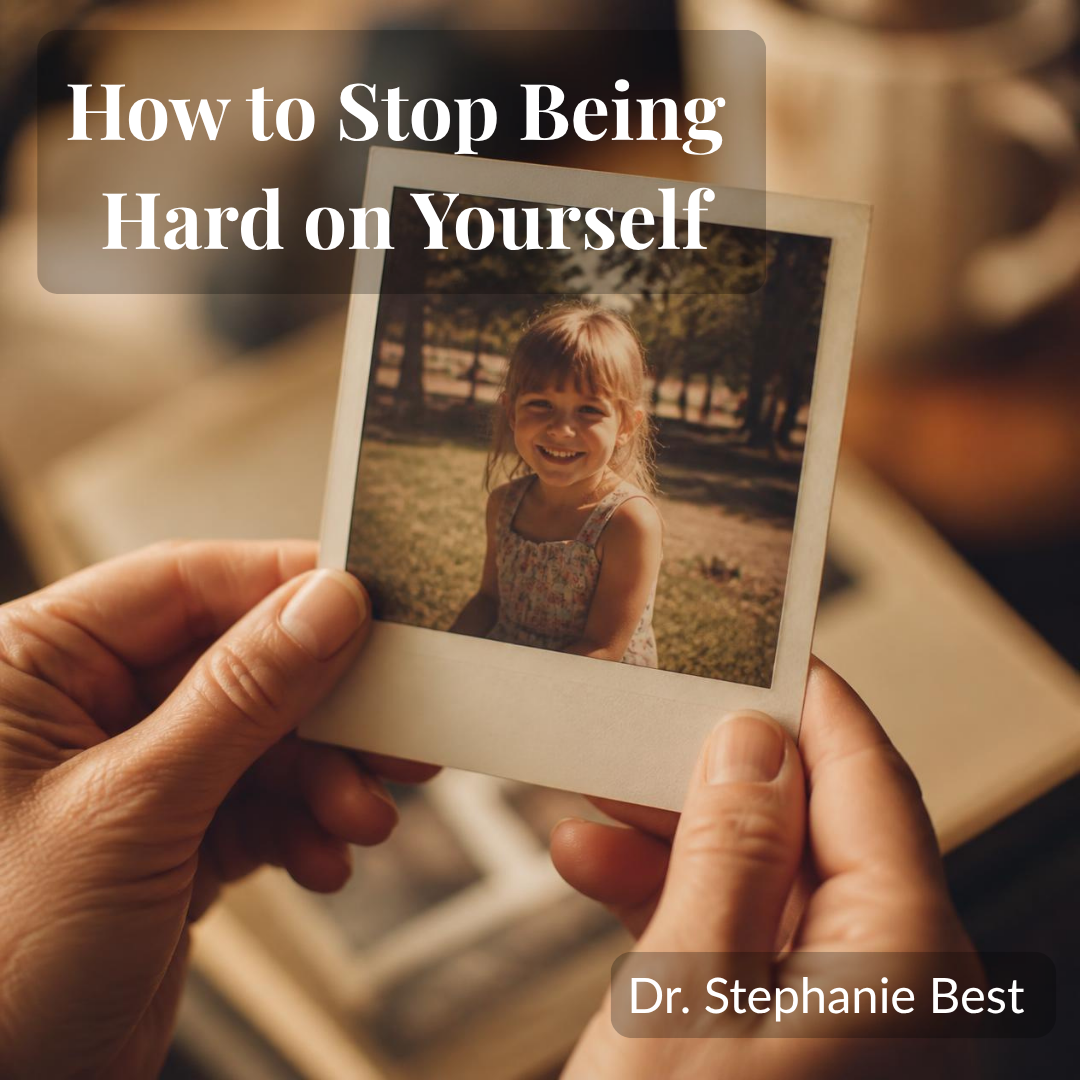
When something genuinely hard happens — a loss, a setback, a week that flattens you — how do you talk to yourself?
For most high achievers, the honest answer is: not kindly. We push through, don't complain, and quietly wonder what's “wrong with us” for not handling things better. We call it standards. Really, it's a habit of being hard on ourselves and mistaking it for grit.
If you've ever wondered how to stop being hard on yourself — not just in theory, but in the moment it actually counts — the research points somewhere unexpected. Not toward more willpower, but toward less harshness. People who practice self-compassion during hard times are actually more resilient, less likely to ruminate, less overwhelmed by stress, and less likely to spiral into hopelessness. 💪🏼
This topic has been personal for me lately. A little over a month ago, I wrote about traveling to Virginia to support a loved one through a serious illness, during the same week I was celebrating my Dad's 80th birthday. Since then, the loved one I was caring for has passed away, and I've found myself back in ‘the grief club’. 💔
I've been paying close attention to how I talk to myself, treat myself, and support myself as I navigate this challenge. Self-compassion has been one of the most helpful tools I’ve used to get through it. Since we are all members of ‘the grief club’ at various times in our lives, I thought I’d share some of what I’ve learned with you. I hope it inspires you to be a better friend to yourself when it’s your turn.
Prefer to watch? Here's the full video:
Why Self-Compassion Makes You More Resilient, Not Weaker | Dr. Stephanie Best
The Real Reason You Can't Stop Being Hard on Yourself
Self-compassion isn't self-indulgence. It's treating yourself the way you'd treat someone you love who's struggling.
Here's the reframe that changed things for me: the part of you that's hurting right now isn't so different from the small child you once were. That child needed kindness, warmth, someone to ask, "Hey, what do you need?" You still carry that child inside you — and most of the time, when things get hard, you skip past compassion and go straight to being hard on yourself instead.
High achievers tend to believe harshness is what keeps the wheels turning. “Push harder! Don't make excuses! Get it together!” But that belief is doing more damage than it's preventing. It's not discipline — it's a self-defeating pattern. Fortunately, it’s one you can learn to loosen, one self check-in at a time. 🌿
What the Research Actually Shows About Self-Compassion and Resilience
This runs counter to almost everything most high achievers believe, but the research is consistent: people who treat themselves with compassion during hard times are more resilient, not less. They ruminate less. They're less overwhelmed by stress. They're less likely to spiral into hopelessness when things go sideways.
Self-compassion doesn't lower your standards; it changes what happens when you fall short of them. Instead of being hard on yourself, you get curious. You spend your energy on self-nurturing instead of self-punishment, on figuring out what you actually need, on learning from the experience, and on getting back to what matters to you. That's not weakness, nor is it the version of you that just white-knuckles through it. It’s the kind of post-traumatic growth that builds wisdom and the kind of resilience that actually holds up under pressure.🌱
The Questions to Ask Your Inner Child (And Why It Works)
Here's an exercise I use with clients — and the one I've been leaning on myself these past few weeks.
Find a photo of yourself as a fairly young child, somewhere between the ages of 6 and 10. (It doesn't have to be exact.) Pick one that easily evokes warm feelings just by looking at it. My ‘mini me’ has pigtails and roller skates. 🛼
Then make the photo your phone wallpaper. Every time you unlock your phone and gaze into that little girl’s eyes, let the photo prompt you to check in with her. Ask yourself:
How am I talking to myself right now?
Would I be OK with talking to her this way?
What does she need right now?
Can I listen to her (I mean really listen)?
Give her a chance to speak. Honor what she's telling you. Then practice giving her what she's asking for — the way you'd respond to a struggling friend, or the way you wish someone had shown up for you back then.
A Simple Self-Compassion Exercise You Can Start Today
This self-compassion exercise doesn't require ‘just the right’ photo or the perfect moment to start. What if you could allow it to be simple? Find the picture tonight. Then make it your phone wallpaper tomorrow morning. That's all it takes to begin.
Over time, with repetition, this can strengthen your most important relationship — the only one you're going to have from your first breath to your last: your relationship with yourself. All wellness grows out of that relationship. Tend to it, and the most beautiful things will bloom. 🌻
Now go find that photo. Ask her what she needs. Watch what shifts. 💛
P.S. If you try this, I'd love to hear how it goes. Email me, leave a comment on the YouTube video, whatever's easiest. I read every message.
Ready to take the next step?
If something here resonated with you, I'd love to stay connected. Here are 3 ways to go deeper:
🌿 Download my FREE guided meditation — a practical first tool for the moments when anxiety gets loud.
💌 Join the Courageous Living newsletter — honest insights, tools you can actually use, and the occasional irreverent truth delivered to your inbox. No spam, no hustle culture.
▶️ Subscribe on YouTube — new videos every few weeks. Radically genuine real-talk psychology that's values-driven and always unscripted.
And if you're in a place where 1-on-1 support feels like the right next step, I'd love to connect. I'm a therapist in Charleston, SC who works with clients across the U.S. via PSYPACT — you can reach out here.
When you're going through something genuinely hard — grief, a setback, a brutal week — how are you talking to yourself?
For most high-achieving humans, the honest answer is not very kindly. We act like a jerk to ourselves, muzzle what we're feeling, or tell ourselves there's something wrong with us for not handling it better.
Hi, I'm Dr. Stephanie Best. I'm a licensed clinical psychologist and I teach people who struggle with anxiety how to liberate themselves from fear through mind-body wellness so they can live more courageously and build lives they love.
Here's what thousands of research studies actually show — and this runs counter to what most high achievers believe. People who treat themselves with compassion during hard times are actually more resilient. They're less likely to ruminate, less overwhelmed by stress, and less likely to spiral into hopelessness.
This stuff has been top of mind for me recently for a very personal reason. You might remember a couple of videos ago I told you about traveling to Virginia to support a loved one going through a serious illness and feeling the pain of that in close proximity to feeling the joy of my father's 80th birthday celebration.
Unfortunately, since I made that video, the loved one I was nurturing has passed away. So I find myself once again in the grief club, and self-compassion has been very important for me these past couple of weeks.
I've been thinking about how I'm treating myself, and I thought maybe you might benefit from hearing some of the tips and strategies I use to support myself through tough times.
Self-compassion, you see, it's not self-indulgence. It's treating yourself the way you treat someone you love who's struggling. The part of you that's hurting right now isn't so different from the small child you once were. That child needed kindness, warmth, and someone to ask, "Hey, what do you need?" And so do you.
In fact, you still carry that child inside of you. Today, I want to teach you how to take better care of her or him.
This is one of my favorite self-compassion tips, and it tends to be one of the most impactful for my clients.
Find a photo of yourself as a fairly young child — maybe somewhere between the ages of 6 and 10, but it doesn't have to be exact — and pick one that when you look at it, evokes warm feelings easily.
Make it your phone wallpaper. Here's mine.
There she is. Pigtails and roller skates and all.
So every time you look at your phone, let that photo prompt you to check in.
Ask yourself: how am I talking to myself right now? Would I be okay talking to her this way? What does this child need right now? Can I listen? Give her a chance to speak. Honor what she's telling me.
And then practice giving her what she's asking for — the way that you'd respond to a struggling friend, or the way that you wish someone had nurtured you back then.
Over time and with repetition, this can be an incredibly effective way to strengthen your most important relationship — the only one that you're going to have from your first breath till your last. And that's your relationship with yourself.
All wellness is rooted in that relationship. Tend to it and the most beautiful things will grow.
If you're going through something hard right now and you could use a compassionate voice, I recorded a free guided meditation that pairs well with what we talked about today. It's a 15-minute practice to soothe you and guide you back to yourself. I'll put the link in the description.
Give this a try. Find that child photo of yourself. Start checking in with her or him — asking what she needs, and practicing giving it to her — and see if it doesn't start to change things for you over time. If it does, message me, leave a comment, let me know how it's going. I can't wait to hear.
I hope that you start to become a better friend to yourself during hard times. I know I'm really trying to do that for myself right now, and it helps.
Until next time — wishing you wellness.